報(bào)告題目:Abiological Self-Assembly: Predesigned Metallacycles and metallacages via Coordination
報(bào) 告 人 :Peter J. Stang院士
報(bào)告時(shí)間:2018年5月13日(周日)上午10:00
報(bào)告地點(diǎn):八號樓三樓報(bào)告廳
邀 請 人 :楊利明研究員
報(bào)告人簡介:
Prof. Peter J. Stang obtained his B.S. of Chemistry in 1963 at DePaul University, Chicago (with Magna Cum Laude), Ph.D. as a NIH Fellow in 1966 at University of California, Berkeley (with A. Streitwieser), and Postdoctoral NIH Fellow from 1966-68 at Princeton University (with Paul Schleyer). Since 1969 he is at University of Utah, now as the distinguished Professor of chemistry and David P. Gardner Presidential Chair at University of Uath. His research interest include molecular architecture via coordination: formation of discrete supramolecular species with well defined geometries and shapes via self-assembly; polyvalent iodine species; alkynyl esters; reactive intermediates (vinyl cations, unsaturated carbenes).
He is a Member of the National Academy of Sciences in 2000, a Fellow of the American Academy of Arts and Sciences in 2002, and a Foreign Member of the Chinese Academy of Sciences in 2006. Prof. Stang is the author or co-author of 555 scientific publications in high impact journals, including seven monographs and two dozen reviews. One of the most cited chemists in molecular architecture and assembly. Prof. Stang has been the editor of the Journal of the American Chemical Society since 2002. He has received many of the honors of his profession, including the National Medal of Science in 2011 and the American Chemical Society Priestley Medal in 2013. To date Prof. Stang has mentored 78 Postdoctoral Associates; 38 students have obtained Ph.D. degrees and 7 students have received M.S. degrees under his direction.
報(bào)告摘要:
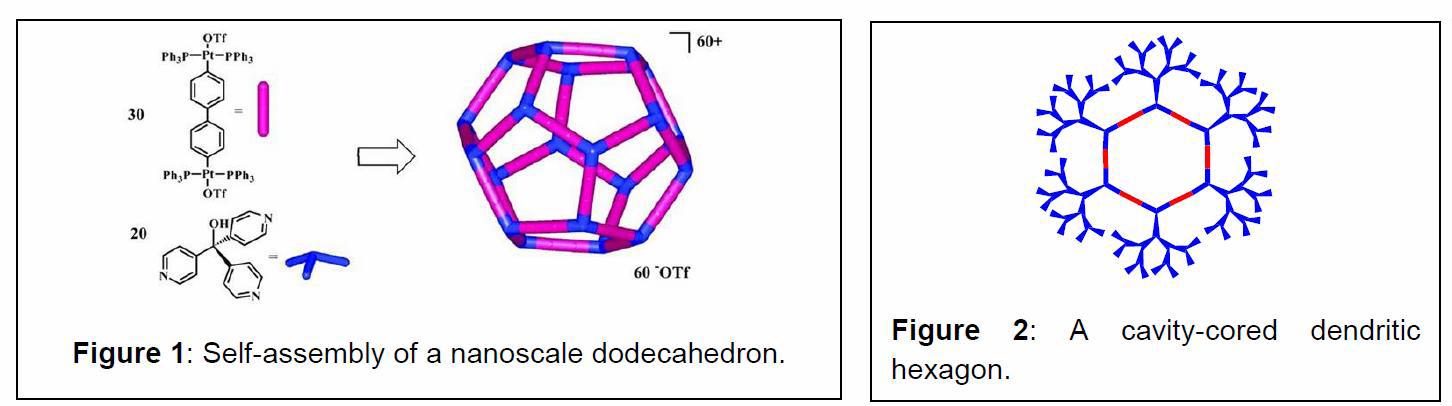
The use of just two types of building blocks, linear and angular, in conjunction with symmetry considerations allows the rational design of a wide range of metallocyclic polygons and polyhedra via the coordination motif. We have used this approach to self-assemble a variety of 2D supramolecular polygons such as triangles, rectangles, squares, hexagons, etc. as well as a number of 3D supramolecular polyhedra: truncated tetrahedra, triginal prisms, cubooctahedra4 and dodecahedra. An example of the methodology is illustrated in Figure 1. More recently we have functionalized these rigid supramolecular scaffolds with different electroactive, host-guest, dendritic (Figure 2), and hydrophobic/hydrophilic moieties and have investigated the properties of these multifunctionalized supramolecular species. Additionally, we have begun to explore the self-assembly of 2D polygons and 3D polyhedra on a variety of surfaces with the aim of developing their potential to be used in device settings. These novel, supramolecular ensembles are characterized by physical and spectral means. The design strategy, formation, characterization and potential uses of these novel metallocyclic assemblies will be discussed, along with our very recent results.